



Despite advances in automation and the growing adoption of AI, many critical or consequential decisions still require human oversight.
Making the right decision in a timely manner depends on information availability. Can AI support human oversight and boost agility when manual interventions are required?
Human oversight remains essential for many decisions
While it’s true that telcos are pursuing automation in general and also that AI can boost automation by enabling autonomous decisions as well as informed actions based on observed events and activities, it’s equally true that there remain numerous activities that require human oversight.
Compliance with policies, regulations and governance requirements mean that people need to be involved, with the requisite authority, to sign-off key decisions. The nature of these will vary from operator to operator and network to network, but such interventions will likely be required for some time to come.
Optimising capacity in the RAN or dynamically adjusting a network slice to ensure that an SLA is maintained do not necessarily impact the overall network or business. But, authorisation to implement an automated rollout of updates or decisions that impact financial goals or security may well require human oversight – or for a slice dedicated to your most valuable customers for which financial risks exceed the normal levels.
Currently, this means that, even if most of a process has been — or could be — automated, the autonomous workflow needs to be paused, so that an overseer can be informed and the appropriate decision taken.
These interruptions are perfectly normal. But, the specific decision may require access to information and, if that data is scattered between silos, then undue delays could be encountered – undermining the agility that other automation efforts have enabled.
AI to consolidate required information and present it to human overseers
What we need, then, is a way in which the necessary information can be made more accessible, at the very moment that the decision needs to be taken. One approach that offers promise here is the adoption of Co-Pilots in processes.
If all steps have been taken in a process or workflow up to the point that the human decision is required, then the responsible person can be alerted (automatically). Instead of manually checking different data sources, an AI Co-Pilot could act as the interface to the requisite data.
Such a Co-Pilot could interface (via APIs or other AI agents) with the data stores and, with a text-based interface, be interrogated by the supervisor. The supervisor can follow the protocols in force to check whatever is needed to support the decision – and, on providing a positive answer, the flow can be resumed with the action being triggered.
At We Are CORTEX, we see great potential for this use of AI. The Co-Pilot could already be prepared with the required data and checkpoints, or it could retrieve the information in response to questions from the human interlocuter.
The supervisor could also validate the data presented against their own procedures and guidelines – to ensure that all safeguards and guardrails are maintained. But instead of checking and cross-checking multiple sources of information, the decision-making process can be consolidated into easier steps that can be executed more rapidly.
The We Are CORTEX Process Co-Pilot
We’ve even introduced new Process Co-Pilots to pilot this concept. They perform the task of aggregating the necessary information for such critical paths in flows supported by the CORTEX platform.
In the enhanced workspace, these chatbots can interact with live CORTEX flows in the production network (or in staging environments before service launch) and enable human users to ask questions about running events when required – accelerating discovery of the information required to make decisions about how the flow should proceed.
The intuitive interface automates the complexity of bringing information from different sources together, as the chatbot performs this task automatically. For example, a user could ask information about the type of router being used during a security incident, and then be informed whether, for example, it’s PE (Private Edge) or CE (Customer Edge).
It means that that the issue can be isolated (core vs customer specific information) and resolved quickly.
Use case-driven AI Co-Pilot adoption
Similarly, a request to understand specific SLA terms could be made when investigating a reported drop in QoS for a given service to a customer segment (for example, valuable B2B subscribers).
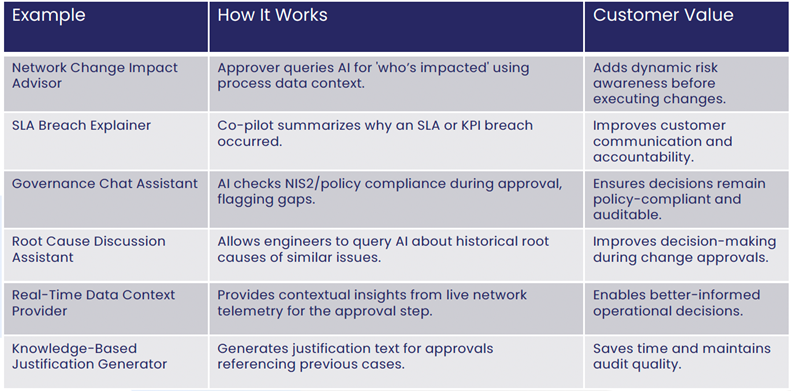
This action could then trigger additional diagnostic flows, based on user inputs, while considering the overall context – such as, which other customers using the same service in different locations are affected by the issue. The versatility of such bots can be seen from the table below.
Table 1: Process Co-Pilot use cases
We think they offer significant promise and will help to sustain operational agility at critical moments and check points. They will help to clarify and accelerate decision making processes while ensuring compliance with network policies and regulatory compliance – because the impacts of many decisions can be far-reaching.
You can explore more of our AI innovations in our recent paper — Telco AI readiness – practical lessons from the We Are CORTEX approach — which highlights a series of similar innovations in AI and shows how innovations can deliver immediate value.
Read our latest paper to find out more.