


NTNs were a big part of the story at Mobile World Congress, with many MNOs announcing that they have partnered with satellite communication providers.
Roaming between PLMN and NTNs is entering the mainstream – but how can you support this if you still depend on manual processes for managing IR documents?
The roaming landscape is changing rapidly. New opportunities for revenue and profit growth are emerging – but these are also bringing new levels of complexity and requirements for your network.
Historically, MNOs were concerned with 3 basic kinds of roaming model:
- Direct interconnection between partner MNOs
- Indirect connectivity with more partners through roaming hubs
- Agreements with MVNOs that sought to create their own roaming relationships.
Effectively, the key stakeholders were all providers of classical mobile services. The growth of IoT services started to change this basic landscape – but at the same time, service definitions were fairly predictable and consistent.
A new IR landscape
That’s changed. Today, there are new types of networks, new kinds of partners – and a whole new level of performance expectations.
As a result, the documents that cover roaming between different operators (IR.21 and IR.85) are set for significant extension – and establishing such agreements and managing changes required by your partners will become a significant challenge.
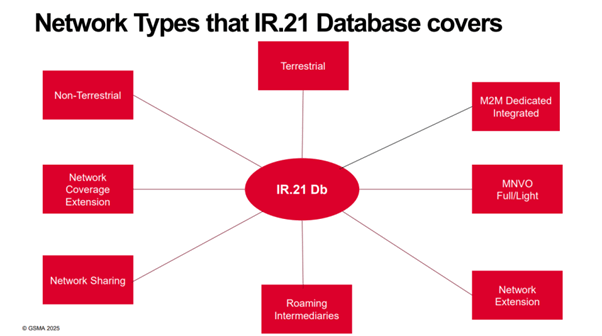
This new landscape has been captured by the GSMA and can be seen below.
Network Types that IR.21 Database covers (Source: GSMA[1])
Building these new partnerships is a significant opportunity – but MNOs cannot afford to fail to support these services and networks, as it can lead to roaming revenue leakage, customer dissatisfaction, reputational damage, loss of roaming services, and more.
Operators need to support roaming between all these networks to enable the services they offer. Take non-terrestrial networks (NTNs) as an example. They offer a significant emerging opportunity, but also roaming complexity challenges when it comes to IR requirements.
NTN use cases are widespread. Some MNOs see them as a convenient way to plug coverage gaps – pushing mobile connectivity to satellite constellation providers to deliver services in remote locations.
NTNs also offer new opportunities for international travellers or continuous coverage while at sea. All of which has captured the attention of the industry – and 3GPP, which unites interests across several leading Standards Development Organisations, has made NTNs integral to its latest releases and updates.
Meanwhile, industry body the GSMA which represents both operators and vendors, has created the NTN Community and other working groups to help translate the standards into guidelines for terrestrial and satellite network interworking and roaming.
Not only have NTNs been baked into 5G standards – they will likely be fundamental to 6G, which has the goal of delivering ubiquitous global services.
Satellite-based roaming is set to boom
That’s because it’s highly unlikely that there will ever be comprehensive, 100% land-level cellular coverage across the globe, despite bold aspirations. Consider the maritime or aerospace sectors, for example. While mobile broadband networks (3G, 4G or 5G) reach more than 95% of the world’s population, the majority of the Earth’s landmass lacks cellular coverage.
So, NTNs will be an increasingly important element in the global roaming ecosystem. Yes, some subscribers may transact separately with an NTN and PLMN provider, but partnership will increasingly be part of the answer as MNOs seek to include satellite connectivity as part of their evolved roaming offers.
In January 2025, for example, Vodafone and AST SpaceMobile made the first satellite-based mobile video call using an unmodified 4G/5G smartphone to a “dead zone” in rural Wales.
Similarly, Virgin Media O2 switched on O2 Satellite, also early in 2026 – essentially a satellite-to-mobile service boosting Virgin Media O2’s UK landmass coverage from 89% to 95%. MWC 2026 saw a rush of similar announcements.
So, NTNs are set to play a significant role when it comes to cellular roaming – and to future network evolution. But this means that the documents that govern relationships between operators — the long-established IR.21 and IR.85 agreements — must also extend to encompass these new requirements, specified performance parameters and operational conditions.
They will become more complex. And there will be more of them. So, given how frequently these documents already change, how will you be able to adapt to an environment in which you not only have a host of new roaming partners, but you also have to meet a whole new set of operational requirements?
The truth is that most MNOs still rely on manual processes to manage their IR documents and the implementation of changes to them in their networks. This has to change.
You need to be able to automate the processing and execution of changes to IR documents when you receive them via the GSMAs RAEX.
To learn more about the opportunities presented by the expanding roaming landscape – and how you can transform your roaming operations and drive growth through automation, read our new paper “Roaming automation: New Revenue, improved margins, and happier customers”.
[1] https://www.gsma.com/get-involved/working-groups/gsma-networks-group/demystifying-roaming-ir-21-and-5g-sa/